Emma Adler
Marc Henry
Liste Basel
Booth 86
15.06. – 21.06.26


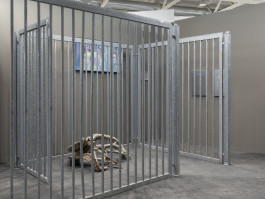
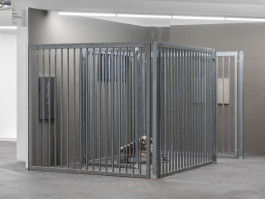
For the presentation at Anton Janizewski’s booth, paintings by Marc Henry and an installation by Emma Adler enter a dialogue. Adler‘s installation reprises a work from 2024 in which she constructed an allegory of recent fascist tendencies. Adler’s installation is the continuation of a show from 2024. For the immersive installation in Basel, Adler equally uses a metal fence that evokes domesticity and a peaceful garden but also the brutal mechanism of inclusion and exclusion. She confronts the viewer with ambivalence: are we included or left out? A video work, shot within the installation, conveys the horror that accompanies the return of the völkisch, that is, the ideology of ethnic purity.
Adler reflects on the concept of truth, because the glitches in AI-generated propaganda images involuntarily reveal the nature of right-wing visual worlds. AI has failed to render credible faces, which results in grotesque, zombie-like distortions. They reveal something about the return of fascist ideology. STRG-Z uses this unintentional ambivalence for an installation, whose center is occupied by a video piece. Adler translates these errors in the image into a video in which zombies, accompanied by peaceful birdsong, perform as respectable and bourgeois, if slightly conservatives; they dance as if celebrating the summer solstice, until events tip over into horror. Zombies figure as revenants of fascism.
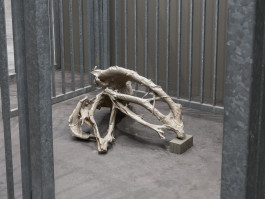
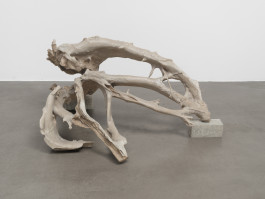
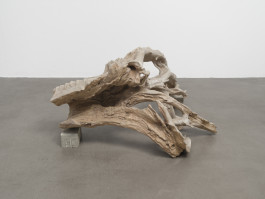
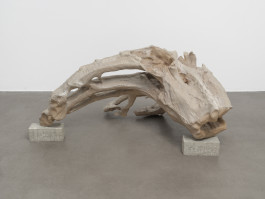
In her analysis, Adler overwrites the source images. Objects and surfaces become, for the artist, shorthand for the modern face of the right that has entrenched itself in parliaments in recent years. In past works she often used materials that pretend to be what they are not—artificial rocks, textures from a video game—as a counter-point to the complex relationship between lie and truth. Into this installation too, she integrates a 3D-printed and overpainted root, grey-brown and glistening, fossil-like. This nature motif recurs in scratch works on aluminium, on which the artist depicts roots that branch and spread like abstract networks. This aesthetic, with its reflective, industrial surfaces, translates almost seamlessly into the exhibition space as an almost minimalist environment. The mechanisms of inclusion and exclusion invite thoughts of home, of Heim; the fear of the Other implies the uncanny—das Unheimliche.
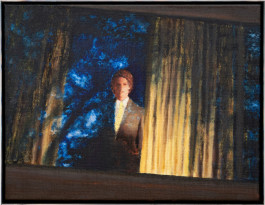
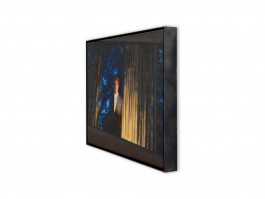
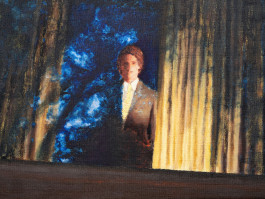
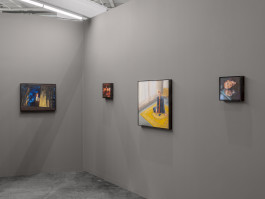
This is present in Marc Henry‘s series of new paintings too. They depict bourgeois interiors, indoor spaces, but above all: gazes. In the oil paintings on linen—which almost mimics film grain—the gaze extends outward. Figures confront viewers, and we do not know whether we are intruders or objects of observation.
In A Beautiful Order, for instance, interior and exterior overlap, reflected in the angular modern window of a residential building behind which a man in a suit can be seen. The trees in the reflection, the view from the window—these are romantic motifs of longing that Henry plays on. The gaze is often directed at something viewers cannot see, as with the figure in The Trade (The Last Man With A Dayjob)—like a cinematic set-up in which the reverse shot is infinitely delayed, and the moment remains in an in-between state. Henry expands these romantic motifs with the repertoire of horror and noir. The paintings suggest frozen moments in a story, as though cut from a narrative, but the decisive thing has already happened: The Last Man With A Dayjob sits on the carpet, phone beside him, like a prop of digital solipsism.
The figures—for instance the woman in Valid Crashout—are tired of capitalist performance, they are reflected multiple times, yet exposed and at the mercy of forces beyond them: not only the gaze of viewers, but also an invisible, abstract system. They are made up, but on the threshold of breakdown.
As with Adler, Henry‘s works too hinge on the blurring of inside and outside. These are images of a withdrawal into the domestic, the home that is all-too familiar, but via the medium of painting, it slides into the strange and dream-like, unfamiliar glitches in familiar settings.
– Philipp Hindahl
German Version
Recent Press
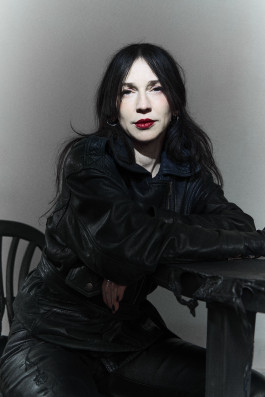
Emma Adler (*1980 in Besch) studied fine arts in Saarbrücken and at the Kunsthochschule Berlin Weißensee.
Adler’s work is currently on view at Kunstmuseum Magdeburg. It has been shown at the Arp Museum Bahnhof Rolandseck, Saarländische Galerie Berlin, Neuer Kunstverein Gießen, Kunsthaus Dahlem, Kunstverein Bremerhaven, Zeppelin Museum Friedrichshafen, and KINDL – Zentrum für zeitgenössische Kunst, Berlin. In 2021, Emma Adler was a fellow of the ZF Art Foundation. In 2022, she received a scholarship from the Stiftung Kunstfonds Bonn, and in 2023, she was a Fellow of the Akademie der Künste Berlin. In 2025, Emma Adler was an Artist-in-Residence at Villa Kamogawa in Kyoto, Japan, by invitation of the Goethe-Institut.
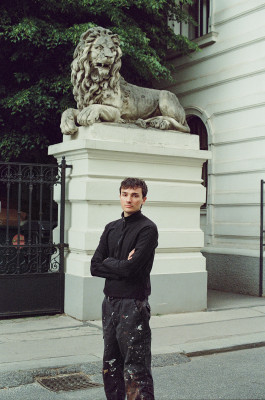
Marc Henry (*1996 in Munich) earned a B.Sc in Economics from LMU Munich and an M.A. in Curating from the University of Applied Arts Vienna, before he graduated from the Academy of Fine Arts Vienna under Daniel Richter.
His work has been shown at Belvedere 21, Vienna; Palais Rasumofsky, Vienna; Galerie Kandlhofer, Vienna; Kunsthalle Oktogon, Hitzacker; Schlossmuseum Murnau; and Kunstverein Rosa-Luxemburg-Platz, Berlin. In 2023, Henry received the Anton Faistauer Prize For Painting. Earlier this year, he was an Artist-in-Residence at Palazzo Monti, Brescia, Italy.
In September, Henry will present his first institutional solo exhibition at Neuer Aachener Kunstverein.
Emma Adler
Marc Henry
Liste Basel
Booth 86
15.06. – 21.06.26
For the presentation at Anton Janizewski’s booth, paintings by Marc Henry and an installation by Emma Adler enter a dialogue. Adler‘s installation reprises a work from 2024 in which she constructed an allegory of recent fascist tendencies. Adler’s installation is the continuation of a show from 2024. For the immersive installation in Basel, Adler equally uses a metal fence that evokes domesticity and a peaceful garden but also the brutal mechanism of inclusion and exclusion. She confronts the viewer with ambivalence: are we included or left out? A video work, shot within the installation, conveys the horror that accompanies the return of the völkisch, that is, the ideology of ethnic purity.
Adler reflects on the concept of truth, because the glitches in AI-generated propaganda images involuntarily reveal the nature of right-wing visual worlds. AI has failed to render credible faces, which results in grotesque, zombie-like distortions. They reveal something about the return of fascist ideology. STRG-Z uses this unintentional ambivalence for an installation, whose center is occupied by a video piece. Adler translates these errors in the image into a video in which zombies, accompanied by peaceful birdsong, perform as respectable and bourgeois, if slightly conservatives; they dance as if celebrating the summer solstice, until events tip over into horror. Zombies figure as revenants of fascism.
In her analysis, Adler overwrites the source images. Objects and surfaces become, for the artist, shorthand for the modern face of the right that has entrenched itself in parliaments in recent years. In past works she often used materials that pretend to be what they are not—artificial rocks, textures from a video game—as a counter-point to the complex relationship between lie and truth. Into this installation too, she integrates a 3D-printed and overpainted root, grey-brown and glistening, fossil-like. This nature motif recurs in scratch works on aluminium, on which the artist depicts roots that branch and spread like abstract networks. This aesthetic, with its reflective, industrial surfaces, translates almost seamlessly into the exhibition space as an almost minimalist environment. The mechanisms of inclusion and exclusion invite thoughts of home, of Heim; the fear of the Other implies the uncanny—das Unheimliche.
This is present in Marc Henry‘s series of new paintings too. They depict bourgeois interiors, indoor spaces, but above all: gazes. In the oil paintings on linen—which almost mimics film grain—the gaze extends outward. Figures confront viewers, and we do not know whether we are intruders or objects of observation. In A Beautiful Order, for instance, interior and exterior overlap, reflected in the angular modern window of a residential building behind which a man in a suit can be seen. The trees in the reflection, the view from the window—these are romantic motifs of longing that Henry plays on. The gaze is often directed at something viewers cannot see, as with the figure in The Trade (The Last Man With A Dayjob)—like a cinematic set-up in which the reverse shot is infinitely delayed, and the moment remains in an in-between state. Henry expands these romantic motifs with the repertoire of horror and noir. The paintings suggest frozen moments in a story, as though cut from a narrative, but the decisive thing has already happened: The Last Man With A Dayjob sits on the carpet, phone beside him, like a prop of digital solipsism.
The figures—for instance the woman in Valid Crashout—are tired of capitalist performance, they are reflected multiple times, yet exposed and at the mercy of forces beyond them: not only the gaze of viewers, but also an invisible, abstract system. They are made up, but on the threshold of breakdown.
As with Adler, Henry‘s works too hinge on the blurring of inside and outside. These are images of a withdrawal into the domestic, the home that is all-too familiar, but via the medium of painting, it slides into the strange and dream-like, unfamiliar glitches in familiar settings.
– Philipp Hindahl
German Version
Recent Press
Emma Adler (*1980 in Besch) studied fine arts in Saarbrücken and at the Kunsthochschule Berlin Weißensee.
Adler’s work is currently on view at Kunstmuseum Magdeburg. It has been shown at the Arp Museum Bahnhof Rolandseck, Saarländische Galerie Berlin, Neuer Kunstverein Gießen, Kunsthaus Dahlem, Kunstverein Bremerhaven, Zeppelin Museum Friedrichshafen, and KINDL – Zentrum für zeitgenössische Kunst, Berlin. In 2021, Emma Adler was a fellow of the ZF Art Foundation. In 2022, she received a scholarship from the Stiftung Kunstfonds Bonn, and in 2023, she was a Fellow of the Akademie der Künste Berlin. In 2025, Emma Adler was an Artist-in-Residence at Villa Kamogawa in Kyoto, Japan, by invitation of the Goethe-Institut.
Marc Henry (*1996 in Munich) earned a B.Sc in Economics from LMU Munich and an M.A. in Curating from the University of Applied Arts Vienna, before he graduated from the Academy of Fine Arts Vienna under Daniel Richter.
His work has been shown at Belvedere 21, Vienna; Palais Rasumofsky, Vienna; Galerie Kandlhofer, Vienna; Kunsthalle Oktogon, Hitzacker; Schlossmuseum Murnau; and Kunstverein Rosa-Luxemburg-Platz, Berlin. In 2023, Henry received the Anton Faistauer Prize For Painting. Earlier this year, he was an Artist-in-Residence at Palazzo Monti, Brescia, Italy.
In September, Henry will present his first institutional solo exhibition at Neuer Aachener Kunstverein.